
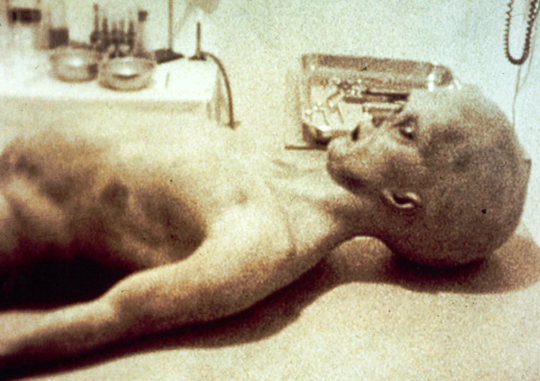
I must admit that this subject has been a real ordeal for me. Many of our readers and fellow researchers may feel the same, because when the Alien Autopsy Film was released in the summer of 1995, it stirred an unprecedented interest in the UFO issue all over the world.
Owned by the British documentary producer Ray Santilli, the film has provoked divisions and fierce confrontations within the international UFO community. The controversy still exists today, even though some light was shed on the case three years ago that pointed towards the direction of a very sophisticated and carefully orchestrated hoax.
My involvement began on March 27, 1995, when I received a dispatch released by the Italian press agency ANSA, which said: “A footage showing a dead extraterrestrial has been announced.” I was at the top level of CUN (Centro Ufologico Nazionale) at the time, and I informed my colleagues on the board about what was happening so that we might get involved immediately. As marketing manager of a very large publishing company in Rome, I had the means to try my best.
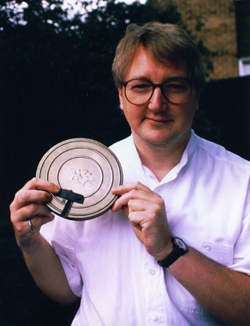
I got in touch immediately with British fellow researcher Philip Mantle, who kindly gave me Ray Santilli’s phone numbers. Ray was very interested in meeting me, and we arranged an appointment for early April in Cannes during the MIP TV – the biggest home video and TV convention in the world.
While having coffee with Santilli at the Martinez Hotel on the Croisette, I realized he lacked basic knowledge about the Roswell Incident and other well-known UFO events, because he was referring to an impact site as Sorocco instead of Socorro. He knew it happened in New Mexico during the summer of 1947, but he stated he was not interested in the UFO community, its U.S. members, and Roswell experts such as Friedman, Schmitt and Randle, among others.
The Human Factor
As for the footage in his hands, Santilli said it was of good quality and consisted of 17 three-minute, black-and-white reels of 16mm original film – for a total of more than 50 minutes. I was shocked when he confirmed that the images depicted the autopsies performed on the bodies of two recovered non-human beings, the site of the crash, the military involved, as well as President Harry Truman being present at the impact site.
However, Santilli stated that the technical processing of the footage from film print to video would create certain challenges. Therefore, he didn’t know when the first public showing of the footage would take place in London. I asked him about the reliability of his source – an 85-year-old man that he called “Jack Barnett” who reportedly took the original film footage and had it preserved in his house for all those years. Santilli said he checked “Barnett’s” identity and believed he was the real deal. Nevertheless, Santilli wouldn’t give me the man’s real name. He would only say the footage was real and came from the U.S. military.
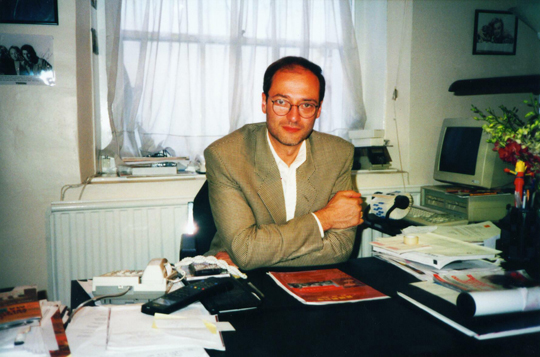
Again I said to him that I was not buying his story without any physical evidence. And he responded adamantly, “Maurizio, this footage will be the Shroud of Ufology. You will never solve the enigma of its authenticity, never.” It was sort of a curse, and today we can say that Santilli was right.
I have to admit I was excited, and I arrived back in Rome with the impression that we finally had real evidence that the Roswell crash really happened, that the U.S. military took everything away, and that they lied for almost 50 years. I hoped the veil could be lifted by what I then defined as “the human factor.”
In fact, however, everything was happening because of one old man’s will to secure some money for his family because he was approaching the end of his days.
OK, yes. I was gullible. I can now admit that.
London, Day One
I arranged a second appointment in London on Tuesday, April 25, 1995. I arrived at Santilli’s office on Balcombe Street at 2 p.m. The label on the street door bell said, “Merlin Group,” Santilli’s company. His secretary Maria introduced me to Ray, and he immediately told me that, because of technical problems in the transfer of the original films to video, he was unable to show me the footage. He suggested I go back to Rome. “No way,” I reacted. And I told him to show me what he had at that moment, in his office.
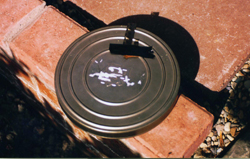
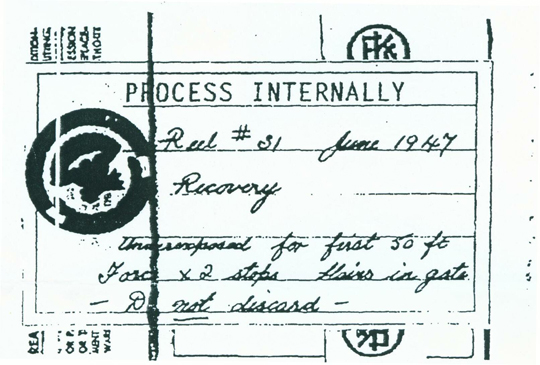
Behind his desk, piled on the floor, there were approximately 15 old canisters, green-grayish in color, each about 25cm in diameter, with labels stamped over, depicting dates and photo-developing instructions. Santilli opened one canister and pulled out a film – maybe 16mm – that appeared to be “pasted.” He said, “You see, the film is damaged and many others are in the same condition. It’s impossible to process it quickly. We need more time.”
Then he showed me the codes, a square and a triangle, labeled on the initial edge of the film that, according to him, belonged to Kodak. I asked him about the Truman clip. “Yes, it’s in there, but it has been damaged, and I doubt we can make up for it.” Upon my persistent request to remain in London and wait to see the film, Santilli told me to return the next day, and to meet him for lunch at noon. Back at the hotel, I crashed on my bed, unfulfilled, but somewhat relieved of the tension of my first frantic day in London.
To be continued…




>>> Again I said to him that I was not buying his story without any physical evidence. And he responded adamantly, “Maurizio, this footage will be the Shroud of Ufology. You will never solve the enigma of its authenticity, never.” It was sort of a curse, and today we can say that Santilli was right. <<<
What a joke. The Shroud of Turin doesn’t have a military record, a home with photos and memorabilia to prove the pedigree of the material and the person whom supposedly took the footage, a wife and kids to back up their fathers claims, the Elvis footage Santilli supposedly bought from this man (where is this footage?), the plane tickets, passport, taxes paid which would be associated with the trip, etc, and other corroborating evidence Santilli says he still has…
And, the Autopsy was supposedly shot in 1947, not AD 1260-1390 one of the given dates for the shroud… Give me a break. What a joke.
>>> I asked him about the Truman clip. “Yes, it’s in there, but it has been damaged, and I doubt we can make up for it.” <<<
Any proof of this footage? Let's a remember, Santilli told the world that the Truman footage was so clear you could read Truman's lips while you watched the footage.
He also stated that they had crash site footage with the craft, the Army equipment, etc.
I say bullshit. Prove me and Philip Mantle assertions wrong.
The alien autopsy film does not have a military record either. All it has is claims from Santilli that cannot be backed up with any real evidence. Santilli has not provided anything that can support his claims. However, there are a number of people including Keith Bateman (the man who faked the tent footage) and Spyros Melaris (the man who led the team that faked the autopsy and debris footage) that can provide supporting evidence to support their claims. Try as you like Maurizio the film is a complete hoax and Santilli is still telling porkies about it.
Regards,
Philip.
Of course, what Philip mantle is stating here is right. My point was IF there was all this material available to back up any of the claims that Santilli has made regarding his video, he would have released SOMETHING, ANYTHING of substance. He didn’t, he hasn’t and he can’t. Because, 1947, 16 mm film with a creature on it, and dated to 1947 does not exist. Nor does the cameraman, a crash site or anything else. Again, if you don’t think so, do some home work and prove us wrong. Show the world a verified crash site, film stock or cameraman and we’ll gladly job on board and beat the drum… “It’s real, it’s real…”
I meam, I know we’re not alone out her but if you guyes SAY that you have the footage, then you say that it’s damaged…. WTF i don’t get it
cool
The Alien Autopsy Footage(or Santilli Footage) officially released is composed by two elements:
– The Second Autopsy film
– The Wreckage film
In both cases Santilli recently claimed that these films came out of a restoration work on some original frames.
The First Autopsy was never release. The alleged on site scene footage (with Truman and the crashed disc) was never shown. Plus, we have the 18 seconds segment inserted at the end of the “Alien Autopsy” 2006 theatrical film.
As UFO researchers, we study this matter, but we are not the owners of any image, nor we claim that it the film was damaged or either. That’s a Santilli’s statement. I know Ray is following this thread, but I bet he will never give us the pleasure of any further detail.
Maurizio Baiata
hallo waar kan ik het wrak ..film vinden? van santilli.? en de orginale kleuren film doco,vaneen duits offisiers dochter.die de mooi foto van de aliën had gemaakt?vr gr burt
Are you ever going to show the footage?